
top of page

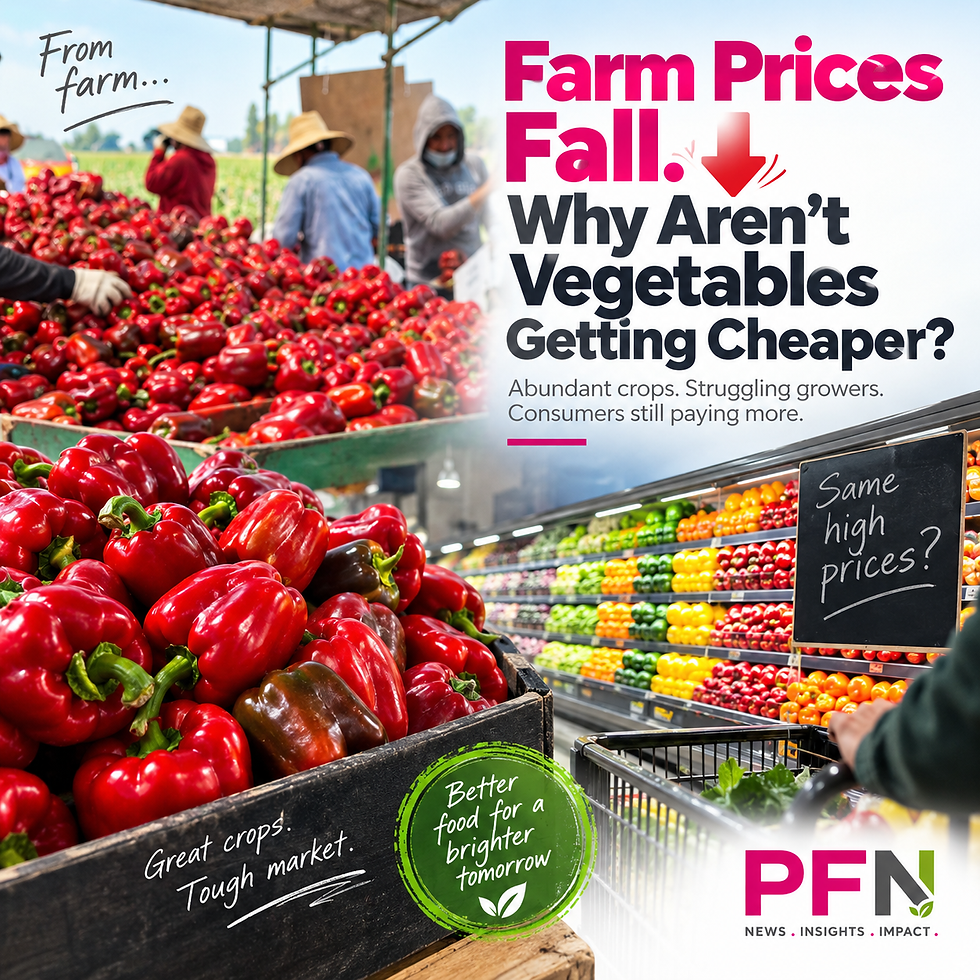
Farm Prices Fall. Why Aren’t Vegetables Getting Cheaper?

8 hours ago
4 min read


Farm_Prices_Fall_Media_Slide

Abundant crops, struggling growers and consumers still watching every dollar are exposing a curious fault line in the fresh produce business. Why aren't vegetables getting cheaper?


After decades in fresh produce and three decades selling peppers, Texas-based produce veteran Paul Manfre says the past three months have been among the hardest he can remember.


Paul is a buyer, seller and shipper with TOP KATZ LLC in Mission, Texas, says a combination of strong growing conditions, increasing production, protected agriculture, consumer financial pressure and recent food-safety concerns has created something approaching a perfect storm.

There is plenty of produce. The problem is moving it.

“The last three months have been the most challenging time in the past 30 years trying to sell peppers, as well as many other items,” Paul Manfre told his industry network.

His concern goes beyond peppers.

Paul argues one of the traditional mechanisms for clearing an agricultural surplus isn't functioning as effectively as it once did.

When produce was abundant, he says, falling wholesale prices historically translated into aggressive retail promotions. Lower shelf prices encouraged consumers to buy more, allowing growers and distributors to clear perishable inventory.

Today, Paul believes that relationship has weakened.

“Price is the #1 mover of fresh produce, but it's almost never used anymore in large retail.”

His contention is that some large retailers maintain produce within relatively consistent retail price bands even when farm and wholesale prices fall sharply.

That is Paul Manfre's assessment rather than evidence by itself of retailer margin expansion.

But current US data make the underlying question difficult to ignore.


Farm down. Retail up.

US Department of Agriculture figures show farm-level fresh vegetable prices fell 29.4% between June and July 2026. They were 19.1% lower than July 2025.


At the supermarket, something very different was happening.

US retail fresh vegetable prices declined just 1.6% between June and July and remained 6.3% higher than a year earlier.

Tomatoes were 12.8% more expensive at retail than in July 2025, lettuce 7.5% higher and potatoes 3.4% higher. USDA currently expects retail fresh vegetable prices to rise about 5.9% across 2026.

That doesn't mean supermarkets are simply pocketing the difference.

Farmgate prices are only one component of retail pricing. Labour, freight, refrigeration, distribution, packaging, shrinkage and store operating costs remain after produce leaves the farm.


But it does reveal something important:


Cheap produce at the farm no longer necessarily means cheap produce for the consumer.

And this isn't confined to the United States.


Australia is seeing its own version

Vegetable growers in North Queensland have recently been confronting an eerily similar combination.

Good growing conditions have produced plentiful, high-quality vegetables at the same time that consumers, pressured by household costs, are reportedly buying less.


North Queensland Farmers chief executive Jenn Honnery put the problem simply: fresh produce has a short shelf life and if consumers aren't buying it, it must eventually be discounted.


AUSVEG meanwhile reported average vegetable-production input costs had risen around 28%, with some growers reporting considerably larger increases.

The result is an extraordinary contradiction: growers struggling to make money producing vegetables while Australians remain well below recommended vegetable consumption.


But greater agricultural productivity only works economically if somebody eats what is produced. And fresh vegetables can't wait indefinitely for customers.

Unlike packaged foods, manufacturers and growers can't simply warehouse peppers, lettuce or tomatoes until demand improves as abundance becomes a liability remarkably quickly.

That raises a bigger question than what happens to this season's pepper crop.


So has fresh produce developed a price-transmission problem?

For decades the agricultural clearing mechanism was relatively straightforward:

Oversupply → wholesale prices fall → retailers promote → consumers buy more → surplus clears.

What Paul Manfre describes looks increasingly like:

Oversupply → farm prices collapse → shelf prices move modestly → consumption remains weak → growers carry the surplus.

If that pattern becomes structural, the implications extend far beyond peppers.


TRENOS SiGINT

SIGNAL — Agricultural abundance is becoming a demand problem

Fresh produce production is becoming more reliable just as financially pressured households are becoming more selective about what goes into the shopping trolley.

The danger is no longer simply crop failure.

In some categories it may increasingly be crop success without sufficient demand.


HUMAN FACTOR

There is an uncomfortable disconnect emerging at opposite ends of the food system.

Consumers believe fresh food is expensive.

Growers believe their produce is becoming too cheap to produce profitably.

Both can be right.


METRICS SNAPSHOT

–29.4% — US FARM-LEVEL FRESH VEGETABLE PRICES

Farm prices fell almost one-third between June and July 2026.

Signal: Significant produce supply was available to the market.

Why it matters: Agricultural abundance should normally create an opportunity to stimulate consumption through price.

–19.1% — FARM PRICES YEAR-ON-YEAR

US farm-level fresh vegetable prices were almost one-fifth below July 2025.

Signal: The weakness isn't simply a tiny weekly market fluctuation.

Why it matters: Growers can experience serious price pressure even while consumers perceive vegetables as expensive.

+6.3% — US RETAIL VEGETABLE PRICES

Retail fresh vegetable prices remained above July 2025 levels.

Signal: Farm-price movements and supermarket-price movements are diverging.

Why it matters: Lower production prices aren't necessarily reaching consumers quickly enough to stimulate additional demand.

+28% — AUSTRALIAN VEGETABLE INPUT COSTS

AUSVEG's May survey found growers' average input costs had increased around 28%.

Signal: Falling selling prices don't necessarily mean falling production costs.

Why it matters: The squeeze can occur simultaneously from both directions — weaker farmgate returns and higher operating costs.


LONG PLAY - Turn abundance back into an advantage

The opportunity isn't necessarily producing fewer vegetables.

It may be getting considerably better at selling abundance.


Fresh produce retailing could increasingly need dynamic seasonal pricing, deeper short-duration promotions and far stronger consumer communication when growing conditions produce unusually large crops.


Technology has helped agriculture become better at producing food.

The next innovation may need to happen between the farm and the shopping trolley.

Because a food system in which farmers cannot profitably sell abundant fresh vegetables while consumers believe those same vegetables are too expensive isn't suffering from a production problem.

It has a connection problem.

And somewhere between those two realities sits one of the more important food-system signals of 2026.


ENDS:

Comments


TOP STORIES

1/168
bottom of page